
Before tears were pathologized, before crying was disciplined or privatized, tears were understood as return.
Human bodies are composed primarily of salt water—the same mineral composition as ancient oceans. Our blood, our lymph, our tears carry the memory of seas older than continents. To cry is not to leak weakness. It is to cycle water back to the earth.
Tears fall downward. They obey gravity. They return what the body has held.

Salt preserves.
Water remembers. It connects all life.
In many Indigenous cosmologies, water is not inert matter—it is ancestor, witness, carrier of story.
Tears are saline because they are not only emotional. They are biological memory release—electrochemical, relational, ecological.
When tears touch soil, they do not disappear.
They re-enter the cycle:
- evaporating
- condensing
- returning as rain
- feeding roots
- moving through rivers
Grief has always known how to move.
It is coloniality that interrupted the flow.

COLONIALITY AND THE INTERRUPTION OF FEELING
Colonial systems required emotional suppression to survive.
Enslavement.
Land theft.
Forced migration.
Gender violence.
Religious conversion.
Border-making.
These systems could not function if people remained emotionally connected—
to land,
to each other,
to their own bodies.
So coloniality trained nervous systems into:
- dissociation
- emotional numbing
- hypervigilance
- containment
- silence
Crying became dangerous.
Not because it was weak—
but because it revealed harm.
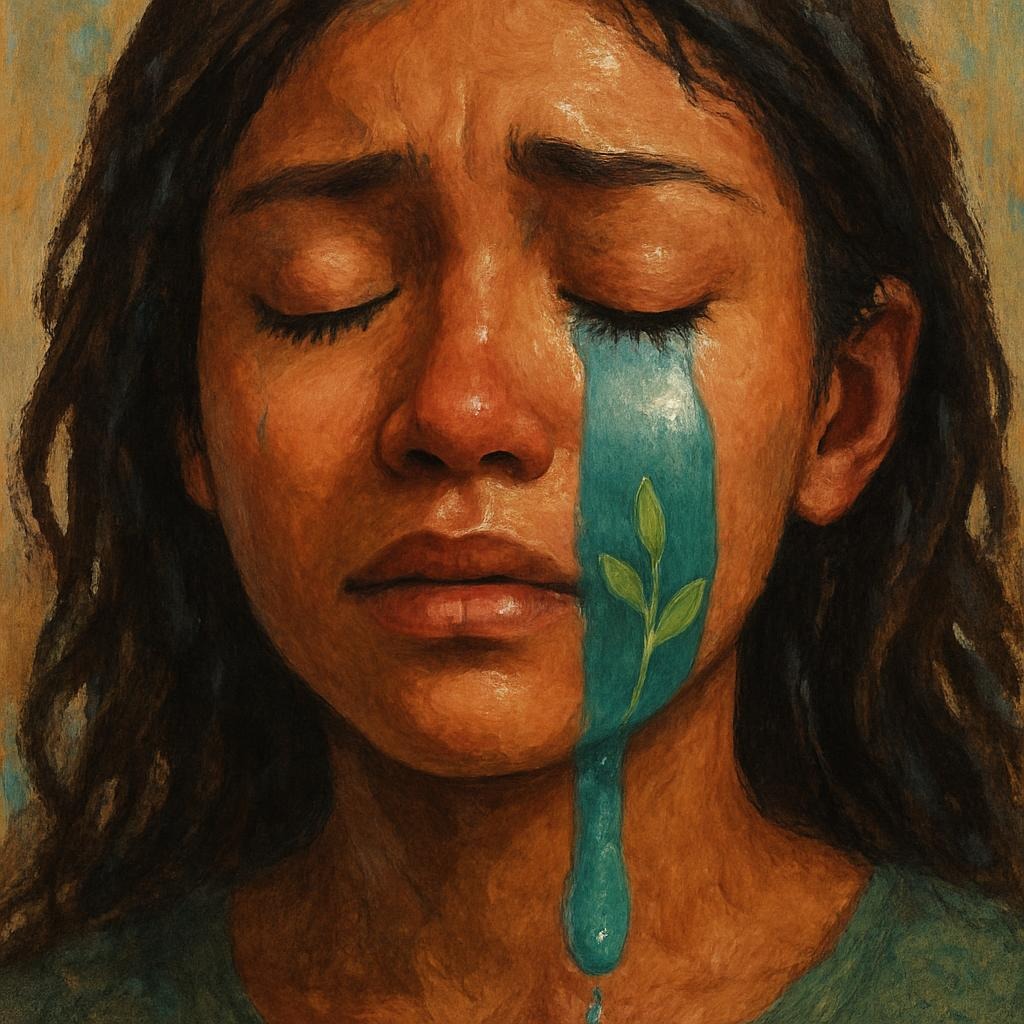
THE RETURN OF TEARS AS RESISTANCE
When tears return, something reopens.
Crying rehydrates what was desiccated by domination.
It re-links body to earth.
It restores rhythm to systems forced into freeze.
Lloronequis names this return.
Not as regression.
Not as collapse.
But as re-membering—
the body recalling how to belong.
Tears soften soil hardened by violence.
They loosen what has been held too long.
WHY THIS MATTERS NOW
We live in an era of emotional exhaustion, burnout, and numbness
because coloniality taught bodies to survive without metabolizing pain.
Lloronequis does not ask us to feel everything at once.
It asks us to restore flow.
To let water move again.
To let grief finish its cycle.
To allow the nervous system to remember safety through connection.
THE NERVOUS SYSTEM AS A COLONIAL SITE
Coloniality does not live only in law or land.
It lives in the body’s reflexes.
Generations were taught:
– do not feel too much
– do not show pain
– do not grieve publicly
– do not let tears gather others
This forced the nervous system into chronic suppression—
a state of survival without resolution.
Disconnection from emotion was not accidental.
It was strategic.
A numbed body is easier to control.
A disconnected body is easier to displace.

Lloronequis holds tears as earthwork—

Lloronequis as an active part of living—
Lloronequis an ethical act of restoration—