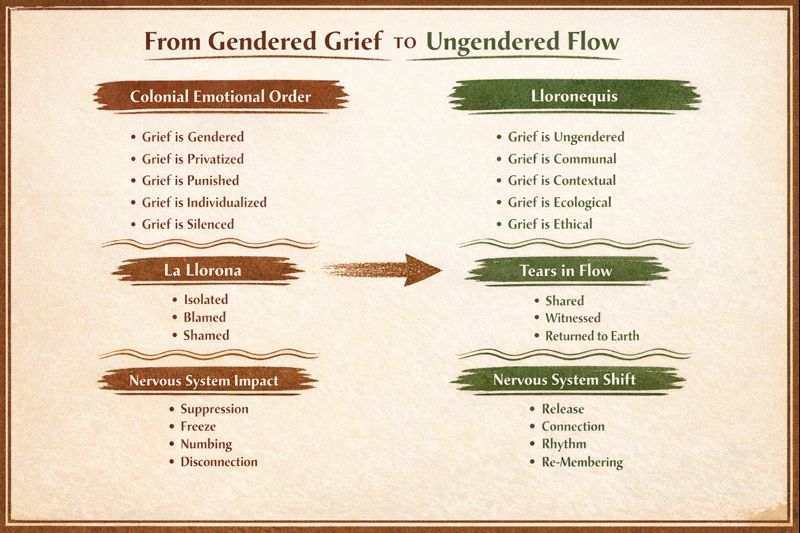
WHAT CHANGES IN UNGENDERED FLOW
When grief is ungendered:
tears no longer belong to women
crying is no longer shameful
emotion is no longer assigned or extracted
grief can move instead of stagnate
Flow replaces containment.
Relation replaces blame.
This is the condition Lloronequis creates.
FROM LLORONEQUIS TO QUEERIDA
If Lloronequis names how grief moves,
Queerida names how we relate once it does.
Lloronequis clears the blockage.
Queerida shapes what becomes possible afterward.
QUEERIDA AS RELATIONAL ETHIC
Queerida is not romance.
It is not sentimentality.
It is not possession.
Queerida is love after domination is refused.
Where coloniality taught:
love as ownership
love as control
love as hierarchy
Queerida insists on:
reciprocity
tenderness without capture
connection without erasure
THE SEQUENCE MATTERS
Grief must move
before love can be ethical.
When tears are suppressed, love becomes distorted—
clinging, consuming, fearful, violent.
Lloronequis restores circulation.
Queerida restores relation.
LLORONEQUIS + QUEERIDA
Together they form an emotional ethic:
Lloronequis allows grief to surface and flow
Queerida teaches us how to stay with one another once it does
One releases.
The other binds—without trapping.
One is water returning to earth.
The other is how we touch without harm.
THIS IS THE COUNTER-STORY
Coloniality said:
Crying women are dangerous.
Love must dominate to survive.
Lloronequis and Queerida respond:
Grief is communal.
Love is responsibility, not possession.
This is not metaphor.
This is practice.
WHY THIS PAIRING MATTERS
Without Lloronequis, love bypasses pain.
Without Queerida, grief reopens harm.
Together, they form:
an ethics of feeling
a decolonial nervous system logic
a way of relating beyond domination